Comment
What is a 'historic town' and why does it matter in the context of Green Belt and grey belt?
The introduction of grey belt policy has sharpened debate around the future of Green Belt land. While early attention focused on previously developed land and questions of openness, one purpose is increasingly shaping decisions: purpose (d), the preservation of the setting and special character of historic towns. So, what is purpose (d) and why is it important?
Preparation for a recent planning hearing, where refusal relied on Green Belt purpose (d), highlighted the historically limited consideration of this purpose and the persistent lack of clarity surrounding its meaning and application. In the below article, Directors in our Heritage, Townscape and Landscape team, Kerrie Melrose and Richard Brookes share their expert insight on the importance of historic towns, how purpose (d) is being assessed in practice, what recent appeal decisions reveal, and why integrated heritage, landscape and planning expertise is essential to navigating grey belt opportunities with confidence.
Green Belt, grey belt and purpose (d)
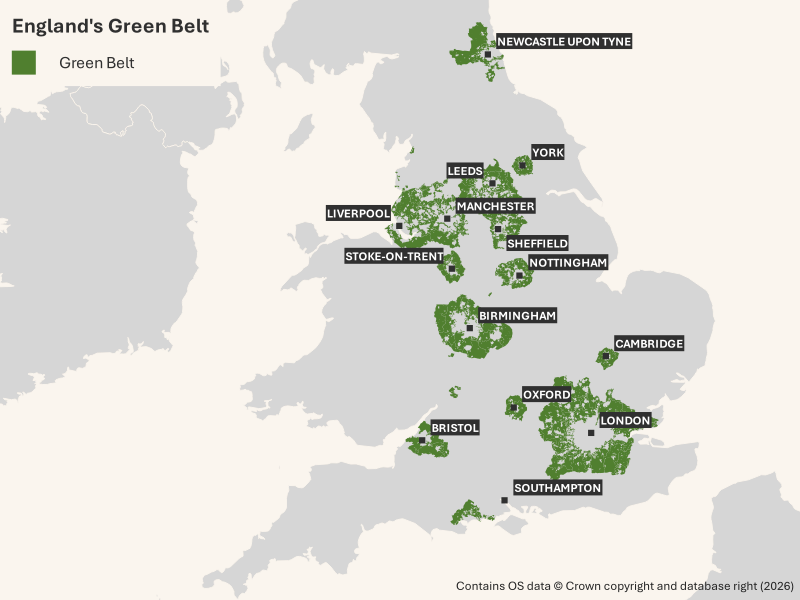
‘Grey belt’ was introduced into the planning glossary through the revised National Planning Policy Framework (NPPF) in December 2024, to the consternation of some local planning authorities, and the excitement of the development industry, which foresaw a more flexible approach to the key planning constraint of the Green Belt. The NPPF (Annex 2) defines grey belt “as land in the Green Belt comprising previously developed land and/or any other land that, in either case, does not strongly contribute to any of purposes (a), (b), or (d) in paragraph 143. ‘Grey belt’ excludes land where the application of the policies relating to the areas or assets in footnote 7 [1] (other than Green Belt) would provide a strong reason for refusing or restricting development.”
Fast forward 12 months and we have the benefit of numerous grey belt application and appeal decisions to aid our understanding of the implications of the revised Green Belt policies. In addition, the draft new NPPF (December 2025) is set to change the shape of national planning Green Belt policy even more significantly.
We have been busy assessing sites and land holdings for our clients to identify potential grey belt land, drawing on our heritage expertise in combination with our planning and landscape colleagues, with particular focus on purpose (d), one of the five purposes of Green Belt set out at paragraph 143 of the current NPPF:
a) to check the unrestricted sprawl of large built-up areas;
b) to prevent neighbouring towns merging into one another;
c) to assist in safeguarding the countryside from encroachment;
d) to preserve the setting and special character of historic towns; and
e) to assist in urban regeneration, by encouraging the recycling of derelict and other urban land.’
What do the terms in purpose (d) mean in practice and to what places do they apply?
Purpose (d) provides three terms – ‘historic towns,’ their ‘setting’ and ‘special character’ – but how are these defined and applied? No definition is included within the NPPF or Planning Practice Guidance (PPG) beyond clarification that a ‘town’ is not a village.
‘Historic towns’ relates, of course, to the broader concept of the historic environment; however, importantly, a ‘historic town’ is not a designated heritage asset in itself (for the purposes of NPPF policy), though it may (and is likely to) contain one or more conservation areas, listed buildings and other heritage assets.
The term is not defined, beyond the 2025 update to PPG making clear that purpose (d) relates to historic towns and ‘not’ villages. From the formal designation of areas of Green Belt and subsequent appeals, we know cities are included, although this is not specifically mentioned in the NPPF/PPG. The lack of formal criteria or clear definition for what would qualify as a ‘historic town’ leaves much room for interpretation and inevitably leads to (sometimes unhelpful) debate between applicants and local planning authorities.
Curiously, the purpose has not always been explicit in relating to the historic environment. When Green Belt policy was first introduced at a national level in 1955, it referred only to preserving the ‘special character of a town.’[2] ‘Historic’ was added in 1988[3] to clarify and narrow the category of towns to which the purpose applied.[4] Subsequently, the purpose became generally accepted as relating to very few settlements in practice,[5] with most towns having expanded with more recent suburban or post-Second World War industrial developments between the historic core and the countryside, thereby forming a new settlement edge. We have already seen a move towards a broader interpretation of a ‘historic town,’ particularly as local authorities look to resist applications based on the identification of land as ‘grey belt.’ While purpose (d) was cited in the establishment of the Green Belts around York, Chester, Oxford, Cambridge, Harrogate and Lancaster, in more recent appeal decisions Inspectors have considered the purpose applicable to a wide range of towns, including Morpeth, Wimborne Minster, Hadlow and Esher.
To a greater or lesser degree, all towns are ‘historic’, with even New Towns having some historic interest or value. Notwithstanding, the NPPF is not referring to all towns and through PPG it is reasonable to interpret a ‘historic town’ as having both ‘historic aspects’ and ‘special character.’ While not defining ‘special character,’ Historic England[6] defines ‘character’ as:
“…a broad concept, often used in relation to entire historic areas and landscapes, to which heritage assets and their settings may contribute.”
It also states that:
“The historic character of a place is the group of qualities derived from its past uses that make it distinctive. This may include: its associations with people, now and through time; its visual aspects; and the features, materials, and spaces associated with its history, including its original configuration and subsequent losses and changes.”
A place’s character can, therefore, be layered and multifaceted, with ‘special character’ being of particular importance beyond the usual, for example having its own historic identity and unique townscape character that sets it apart from other settlements. There are likely to be few historic towns where their ‘special character’ extends to the town as a whole. The lack of a rigid definition within the NPPF and PPG as to whether a ‘historic town’ comprises solely the historic core, the town as a whole or something in between reflects the discretionary nature of the English planning system, with the need for professional and informed judgement to be applied to the specifics of each case.
We have seen through past practice that historic towns were sometimes defined somewhat crudely based on whether they are mentioned in Doomsday Book and/or have a conservation area. Our approach has been to analyse the history and evolution of a settlement; understanding its historic form and special character, as well the extent of survival and legibility, including the concentration of heritage assets, such as listed buildings or conservations areas.
It can feel like a long road just to get to a point of determining whether a settlement constitutes a ‘historic town’ and, therefore, whether purpose (d) is applicable.
Assessing a site’s contribution to purpose (d)
Paragraph 005 of the PPG[7], available to view at this link, sets out the framework for assessing the degree to which land contributes to purpose (d) (i.e. to preserve the setting and special character of historic towns). There are three levels: Strong, Moderate and Weak or None. Importantly, in reference to the definition of grey belt, the relevant consideration is solely whether a site makes a strong contribution to purpose (d) - that is, whether a site is free of existing development AND forms part of the setting of the historic town AND makes a considerable contribution to its special character.
‘Setting’ is not expressly defined in reference to purpose (d), though it is a well-established concept in relation to heritage assets. PPG Paragraph 005 refers to the visual, physical and experiential connections and relationships with historic aspects of the town, which aligns with the NPPF definition and PPG guidance in relation to the setting of heritage assets. The relevant consideration is how a site contributes to the special character of the historic town as part of its setting. This was reiterated by the Inspector at an allowed appeal by Barrett David Wilson in Huntington, York who stated:
“It follows that the setting is not a heritage designation. Its importance lies in the contribution it makes to the significance of the asset, in this case the historic city. It is not therefore enough to assert that a site is in the setting of the historic city. There must also be an impact on the significance of the historic city.”[8]
At another appeal for land in the York Green Belt, the Inspector noted that “The experience on site is of being no more or less than being close to the edge of an urban area. There is no perception of the historic nature of the city.”[9] Similar could be said for many sites on the edge of a historic town and those separated from its historic aspects by later areas of development that are not of special interest.
The case for integrated expertise
Establishing whether a town is a ‘historic town,’ identifying its ‘historic aspects,’ assessing its ‘special character’ and setting, as well as the contribution made by a site, requires specialist heritage expertise, alongside the disciplines of landscape and townscape analysis, visual and openness assessment, and broader planning matters in relation to the Green Belt. The value of such expert advice is highlighted by the significant scope for subjective interpretation. Planners and other professionals in the field will, therefore, continue to seek to test these definitions through practice, as the weight of plan-making, planning appeal decisions and case law on these matters further informs what the key shared principles of approach should be nationally.
The introduction of grey belt policy means that conclusions drawn from pre-2025 Green Belt assessments can no longer be taken at face value. Both existing and new sites now require robust, well-evidenced analysis to determine whether a settlement qualifies as a ‘historic town’ and to assess the extent to which land makes a strong contribution to purpose (d).
We provide integrated advisory support to unlock potential grey belt land, combining planning, landscape, heritage, and strategic communications expertise to deliver policy-compliant, commercially viable, environmentally responsible, and well-articulated developments. Our joined-up approach ensures that opportunities are identified early, risks are managed effectively, and proposals are positioned to respond positively to national and local policy and political objectives.
Find out more information on our expertise in assessing the setting and special character of historic towns in reference to Green Belt purpose (d) and identification of grey belt land here.
To discuss how we can support your project, please get in touch with Kerrie Melrose or Richard Brookes. Kerrie will be attending UKREiiF 2026 and engaging with industry colleagues on grey belt considerations - please contact her directly to arrange a meeting during the event.
27 April 2026
[1] While the draft NPPF proposes omitting Footnote 7, landscape and heritage considerations remain firmly embedded in legislation, existing policy, and statutory obligations. These matters therefore continue to carry significant weight and should be addressed from the outset of any proposal. Our landscape and heritage team can provide informed early-stage feasibility advice to help identify and manage potential implications.
[2] MHLG (1955) Green Belts, Circular 42/55 London HMSO
[3] Department of the Environment (1988) Green Belts PPG2
[4] Department of the Environment (1993) The Effectiveness of Green Belts. HMSO
[5] Local Government Association and the Planning Advisory Service (2015). Planning on the Doorstep: The Big Issues – Green Belt
[6] Historic England (2017) Good Practice Advice Note 3. The Setting of Heritage Assets
[7] Purpose D – to preserve the setting and special character of historic towns
[8] APP/C2741/W/21/3282598 21/00305/OUTM LAND TO THE EAST OF NEW LANE, HUNTINGTON, YORK, YO32 9NA (IR200-201)
[9] APP/C2741/W/25/3362064 Land at Murton Way, Osbaldwick, York, YO19 5UP