Comment
A look ahead to the local elections in Greater Manchester 2026
Local elections will take place across England on 7 May 2026, alongside elections to the Scottish Parliament and the Senedd, against a backdrop of growing political volatility. In Greater Manchester, these dynamics are expected to be pronounced, with shifting voter coalitions and the rise of smaller parties likely to test the resilience of the region’s traditionally stable political settlement.
In this second article as part of our local elections series, Assistant Consultant, Brendan Lovatt, examines how emerging patterns of electoral fragmentation could reshape decision making and collective leadership across Greater Manchester following the May elections.
The current situation political situation in Greater Manchester
In recent years Greater Manchester has benefited from a degree of political stability that has enabled collective working towards shared priorities, delivering tangible successes like Places for Everyone (formerly the Greater Manchester Spatial Framework), the strategic plan for development across the region. However, that model has already shown signs of strain with Stockport Council’s withdrawal from the joint plan in December 2020 and Oldham Council’s vote to withdraw in February 2025. With the May elections likely to further fragment the political landscape, underlying tensions across the ten boroughs may intensify, testing the resilience of the region’s collective leadership.
What could happen at the local elections?
The Gorton and Denton by-election[1] was a timely reminder that electoral outcomes in 2026 are becoming increasingly challenging to accurately predict. In May, Greater Manchester will be an important test of how fragmented the political landscape has become, as the Labour Government seeks to fight off questions of its political health and new Green, Reform and local independent candidates look to make important gains.
The political geography of traditional Labour strongholds like Wigan, Tameside, Manchester and Trafford illustrate the fundamental political problem facing Labour, that manifested in Gorton and Denton. Across Greater Manchester, younger and transient voters in suburban and inner-urban wards are increasingly drawn towards the Green Party, which, coupled with Reform’s appeal across post-industrial communities, is leaving Labour increasingly squeezed out, losing votes across multiple key demographic groups.
In the commuter wards across south Manchester, Green and other progressive candidates are campaigning heavily anticipating that they can mobilise around issues like the cost-of-living and war in the Middle East to take votes away from Labour incumbents. Meanwhile, Reform are likely to focus on traditionally working-class wards in boroughs such as Oldham and Tameside.
Consequently, the electoral landscape of these traditionally Labour voting authorities is becoming more contested for differing reasons, with seats previously thought of as safe Labour ground now in play for candidates across parties of different political colours.
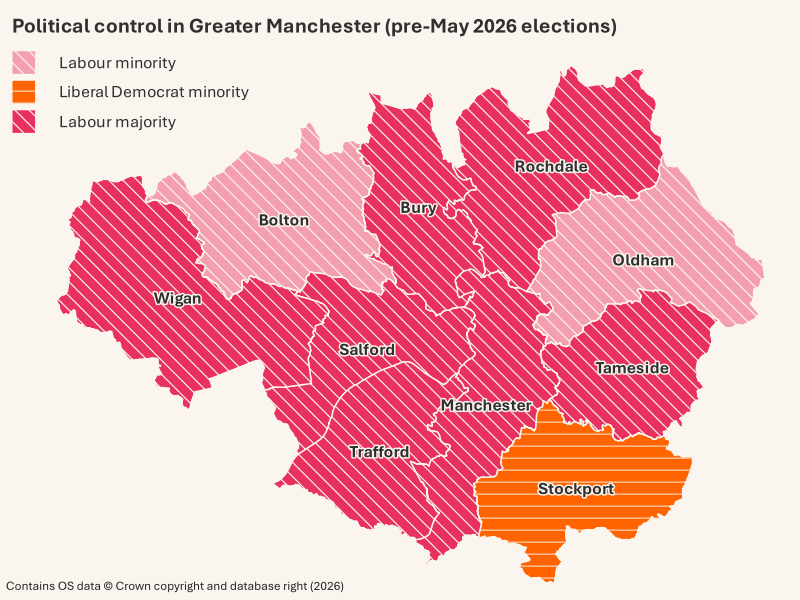
Owing to the relatively stable majorities of those authorities, a complete political shift is unlikely, largely due to Greater Manchester local authorities electing councillors in thirds rather than all in one go. However, this might not prevent councils with slim majorities like Bolton, Oldham and Stockport becoming even more divided. Minority administrations there are operating with established opposition voices, giving subtle shifts in the electoral map more profound consequence.
In Bolton, Oldham and Stockport, Reform and the Greens currently represent just seven out of a total of 183 sitting councillors. However, with these two parties now regularly leading national polling above the two main ‘traditional’ parties, this momentum is expected to result in significant local gains in May, introducing greater fragmentation into already fractured authorities.
Following the elections on 7 May, authorities like those above could have as many as seven or eight political groupings represented in relatively even numbers, owing to the two-way collapse in the Labour vote. In these circumstances, decision-making is likely to depend on issue-specific, locally driven consensus between parties, particularly within increasingly politicised planning committees. A large intake of new councillors could also reshape committee dynamics, with members bringing different local priorities and less established positions on development.
We are continuing to monitor the key races and political situation across Greater Manchester. If you would like to discuss how the upcoming local elections may affect projects you are working on across the North West, please get in touch with Brendan Lovatt.
22 April 2026