
Comment
A new phase for Scottish politics: charting a course to May 2026
The third in our series spotlighting the elections taking place on 7 May 2026 focuses on Scotland. Former Aberdeen Councillor and Assistant Consultant, Strategic Communications, Philip Sellar explains the changes we have already seen since 2021, the importance of this political context and the impact that the forthcoming election may have.
Scotland’s political landscape ahead of May
With recent polling suggesting that the SNP will likely be returned as the biggest political party in Scotland, the big questions that will be answered on 7 May 2026 are whether Reform will beat Labour to second place, what effect will this have on the formation of a government and what will the knock on effects be for the local government elections in 2027?
This article sets the scene ahead of the polls in Scotland opening on 7 May 2026 and gives a sense of what has changed since 2021, and why that is important for 2026 and beyond.
2021 and its aftermath
The 2021 Scottish Parliament election took place at the height of the pandemic, a period when incumbent governments worldwide benefited from a “Covid bounce”. Scotland was no exception. First Minister Nicola Sturgeon was widely seen as handling the pandemic well, and the SNP entered the campaign in a strong position.
The SNP’s dominance since the 2014 independence referendum has been shaped by constitutional politics. By 2021, expectations were that the SNP would advance further, while the Conservatives might slip following Ruth Davidson’s resignation and Boris Johnson’s unpopularity in Scotland. Labour and the Greens had both undergone leadership changes, and Alex Salmond returned to frontline politics with the launch of Alba.
In the event, the results brought little change. The SNP gained one seat to reach 64, just shy of an overall majority. The Conservatives held on to 31 seats, Labour fell back to 22, the Greens rose to 8, and the Liberal Democrats dropped to 4. Alba failed to win representation.
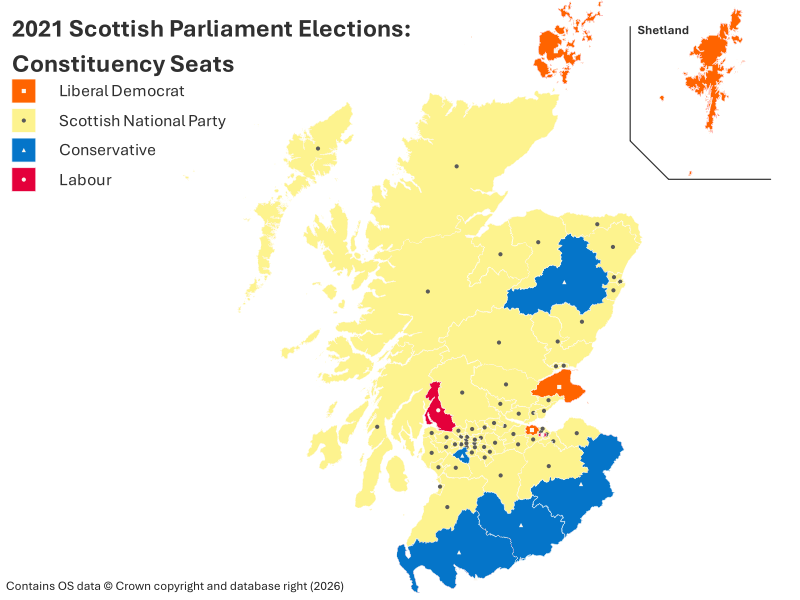
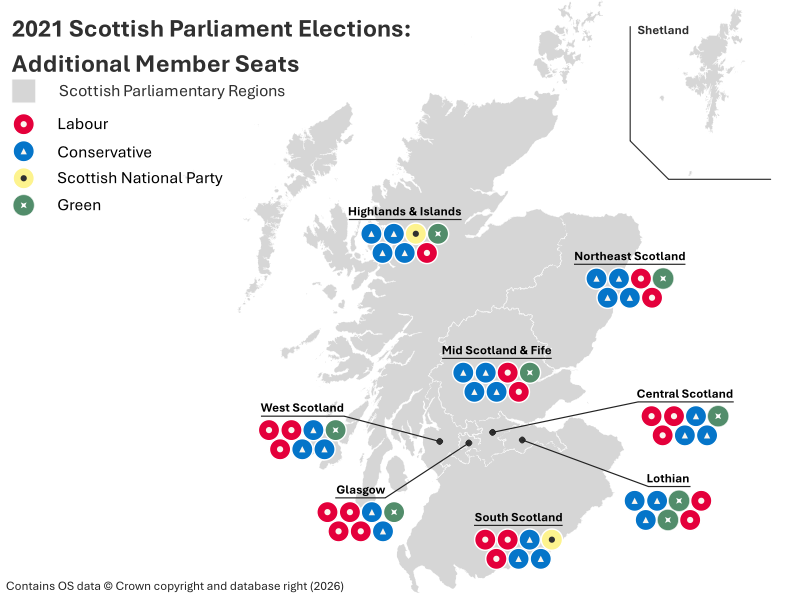
Lacking a majority, Sturgeon entered the Bute House Agreement with the Scottish Greens in August 2021. The deal provided a shared programme on climate, poverty, the economy and the constitution, and brought the Greens into government for the first time. However, the agreement became increasingly contentious within the SNP, with concerns about Green influence and the political focus on contentious policy areas.
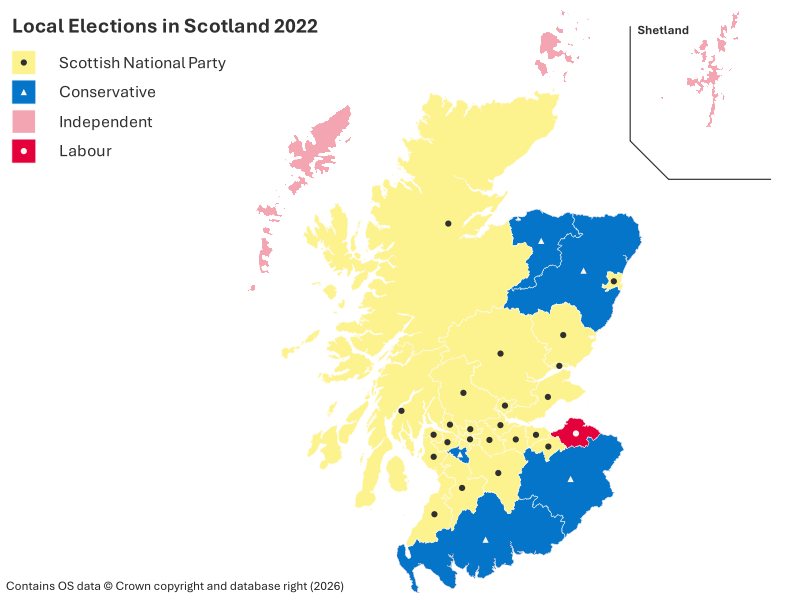
These tensions coincided with mounting internal and external pressures on Sturgeon, who later resigned in March 2023, triggering a leadership election.
Leadership changes and the 2024 General Election
The contest that followed exposed divisions over the Bute House Agreement. Humza Yousaf, viewed as the continuity candidate, ultimately won but struggled to stabilise the party. In May 2024, amid worsening polling and without the numbers to survive a confidence vote, Yousaf scrapped the agreement and resigned shortly afterwards.
John Swinney returned as SNP leader without a contest, with Kate Forbes appointed Deputy First Minister. He inherited a party damaged by scandal and factionalism, just as Rishi Sunak called an early UK General Election.
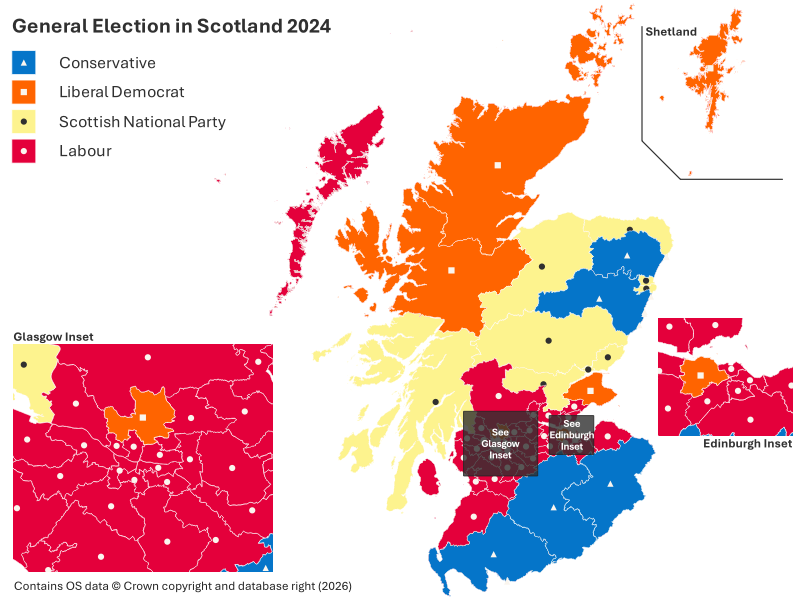
That election proved significant. For the first time since 2014, constitutional politics was not the dominant campaign issue. Instead, voters focused on removing a tired UK Conservative Government. Labour benefited most, winning a landslide UK wide and emerging as the largest party in Scotland at Westminster for the first time since 2010. The SNP suffered its worst result in over a decade.
The picture going into 7 May 2026
In the immediate aftermath, Scottish Labour enjoyed a brief polling boost, even drawing level with the SNP. But the UK Labour Government failed to enjoy a honeymoon period, instead becoming mired in policy reversals, internal disputes and poor approval ratings. This has blunted Scottish Labour’s momentum, despite a notable by election win in Hamilton, Larkhall and Stonehouse in June 2025.
Anas Sarwar has attempted to distance Scottish Labour from Westminster, including publicly calling for Keir Starmer’s resignation following the Mandelson scandal. Labour’s campaign will focus heavily on the cost of living and public services, particularly the NHS.
With polling relatively stable[1], the SNP are still expected to emerge as the largest party in May, though well down on their 2021 vote share. The central question is whether they can secure a majority or must again seek support from other parties. A renewed arrangement with the Greens is possible, but co-operation with the Liberal Democrats can’t be ruled out.
The battle for second place will prove just as significant in May as both Labour and the Conservatives have seen support drain away since the General Election, creating space for smaller parties. Reform UK is polling strongly in Scotland[2], drawing support from both unionist and pro independence voters disillusioned with the status quo. Its rise poses a serious threat to both Labour and the Conservatives.
The Conservatives look set for a difficult election and risk their worst result since devolution, potentially retreating into regional heartlands rather than remaining a national force. The Greens, meanwhile, will hope to capitalise on growing environmental and anti-establishment sentiment, positioning themselves once again as potential kingmakers.
Final thoughts
While the constitution remains part of the background, polling suggests Scots’ priorities are now firmly focused on the economy, the cost of living, public services and immigration[3]. Crucially, a higher than normal share of voters say they are open to changing their minds during the campaign.
With the SNP set to be returned as the largest party, Reform seems likely to take second place, with polling suggesting they may take 20% of all votes cast. This presents a significant challenge in the formation of a government with the SNP publicly stating their opposition to entering a coalition with Reform. This may still leave the door open to an SNP/Lib Dem or SNP/Greens arrangement mix, similar to the resulting government formed after the 2021 election.
Should Reform be returned as the largest party of opposition, this presents significant implications for the local election in 2027. Reform have demonstrated that at local level in English councils, they will actively oppose large-scale renewable projects[4] pushing back on climate targets. In Scotland, they have outlined that this will translate into greater support for reopening oil and gas opportunities in the North Sea and are still yet unproven on accelerating housing delivery.
With voter volatility, fragmentation on the left and right, and widespread dissatisfaction with Government at both Holyrood and Westminster, the final weeks of the campaign remain highly fluid. For all the apparent stability in the polls, there is still much to play for.
For more information on the political situation in Scotland please contact Philp Sellar.
29 April 2026
Key contacts

Michael Jardine
Associate Director, Strategic Communications